


Battle of New Orleans – 1815 Battle Illustration Map
Battle of New Orleans – 1815 Battle Illustration Map
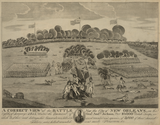
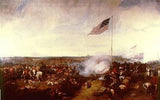
This historic battle illustration depicts the decisive American victory at the Battle of New Orleans, one of the final and most dramatic engagements of the War of 1812. Fought near the city of New Orleans, this conflict cemented Major General Andrew Jackson’s legacy and reshaped American national confidence in the early republic.
Historical Context
The Battle of New Orleans was fought between December 14, 1814, and January 18, 1815, with the decisive engagement occurring on January 8, 1815. Although the Treaty of Ghent—formally ending the War of 1812—had been signed on December 24, 1814, news of the treaty had not yet reached North America. As a result, British and American forces continued to fight, culminating in a final major battle after the war had technically concluded. Leading a diverse and outnumbered American force composed of regulars, militia, free Black soldiers, Native American allies, and pirates, Andrew Jackson constructed formidable defensive works that shattered repeated British assaults and denied Britain access to the Mississippi River and the American interior.
The Map’s Features
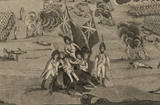
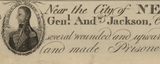
This period illustration presents a dramatic and symbolic view of the battle, showing British troops advancing under heavy fire toward entrenched American lines. British officers are depicted carrying their mortally wounded commander, Major General Sir Edward Pakenham, while American forces maintain disciplined formations behind earthworks. At the center foreground, General Andrew Jackson is prominently portrayed as the commanding figure directing the defense. Smoke-filled artillery exchanges, troop formations, and battlefield chaos are rendered in a stylized manner typical of early 19th-century battle engravings.
Historical Significance
The American victory at New Orleans was one of the most lopsided battlefield successes in U.S. military history, with British forces suffering severe casualties while American losses were comparatively light. Though the battle did not affect the treaty outcome, it had enormous political and cultural impact, elevating Andrew Jackson to national prominence and reinforcing American confidence in its independence and military capability. This illustration captures the moment that transformed a regional commander into a national hero and marked the symbolic end of the War of 1812.
Museum-Quality Reproduction
This is a high-quality reproduction of an early 19th-century battle illustration, professionally printed using museum-grade methods to preserve fine engraved details, tonal depth, and period character. Each print is produced on archival Hahnemühle paper using the Giclée printing process, ensuring exceptional clarity, durability, and a refined finish suitable for long-term display.
Perfect For:
• War of 1812 historians and collectors
• Military history enthusiasts
• Early American history displays
• Offices, libraries, and study spaces
• Gifts honoring American military heritage
• Commemorative collections and educational settings
Specifications:
• Conflict: War of 1812
• Battle: Battle of New Orleans
• Result: American Victory
• Created / Published: Circa 1815–1820
• Style: Early 19th-century battle illustration
• Product Type: High-Quality Reproduction Print
Dimensions (Width x Height): 24.2 x 19
Each map is printed using the finest materials and methods. Your map will be handled with white gloves from start to finish. We use the Giclée printing method on Hahnemühle paper, which produces a clear, extremely detailed, durable map perfect for proud display in your home or office.
Digital watermark does not appear on your purchased map.


